Best Gua Sha for Dry Skin: ANUA Cream Leads

Six gua sha picks compared on the one thing dry skin cares about: how much slip you get before the tool starts dragging. Includes a built-in-roller cream, two stone tools, a brush hybrid and two oils.

By Harley BradleyUpdated 17 min read
On this page
- Best gua sha for dry skin at a glance
- Which buyer does each of these actually suit?
- Why does slip decide the best gua sha for dry skin?
- 1. ANUA Collagen Retinol Refining Gua Sha Cream — Best overall
- 2. Rena Chris Gua Sha Facial Tools — Best budget pick
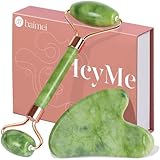
- 3. BAIMEI IcyMe Gua Sha & Jade Roller Set for Facial — Most versatile
- 4. Kate Blanc Cosmetics Organic Jojoba Oil for Hair — Best minimal setup
- 5. GEMELLE Lymphatic Gua Sha Face Oil — Best for families
- 6. SEFVAKO Lymphatic Contour Face Brush — Best upgrade
- Stone, steel or a cream with a roller built in?
- What the listings do not tell you about dry skin
- How to build a routine around the best gua sha for dry skin
- The verdict
- FAQ
The best gua sha for dry skin is the ANUA Collagen Retinol Refining Gua Sha Cream, because its 2.71 fl oz tube supplies the slip and the W-shaped tool head in one product, and dry skin fails on slip long before it fails on stone. If you already own a tool you like, the Rena Chris stainless steel gua sha is the cheapest pick of the six and pairs with any oil in your cabinet.
Most guides for this category argue about jade versus rose quartz versus steel. That is not what splits this field. What splits it is the medium: how much glide sits between the edge and your face, and how long it stays there before the tool starts to drag. Dry skin runs out of slip in about ninety seconds with a thin serum. A stone that drags is a stone that pulls, and pulling is the one thing you are trying to avoid.
Best gua sha for dry skin at a glance
| Pick | What you get | Slip source | Price |
|---|---|---|---|
Best overall ANUA Collagen Retinol Refining Gua Sha Cream |
Cream with built-in W-head roller | 2.71 fl oz cream, included | Check Price |
Best budget pick Rena Chris Gua Sha Facial Tools |
1 stainless steel tool, 3.17 oz | Bring your own oil | Check Price |
Most versatile BAIMEI IcyMe Gua Sha & Jade Roller Set |
2-piece jade set, 3.53 oz | Bring your own oil | Check Price |
Best minimal setup Kate Blanc Organic Jojoba Oil |
2 fl oz jojoba oil, amber glass | 2 fl oz oil, no tool | Check Price |
Best for families GEMELLE Lymphatic Gua Sha Face Oil |
0.5 fl oz botanical oil | 0.5 fl oz oil, no tool | Check Price |
Best upgrade SEFVAKO Lymphatic Contour Face Brush |
Dual-ended brush plus jade edge | Bring your own oil | Check Price |



Which buyer does each of these actually suit?
These six picks are not six versions of the same thing. Three are tools, two are oils, and one is a cream with a tool attached. That means the honest way to sort them is by who is standing in front of the bathroom mirror, not by which stone is prettiest.
Here are the profiles I mapped the picks to:
- The person starting from zero. No tool, no facial oil, no routine. The ANUA cream covers both halves in one 2.71 fl oz tube, which is why it wins.
- The person who owns a tool already. You need slip, not another stone. Kate Blanc's 2 fl oz jojoba or GEMELLE's 0.5 fl oz oil both slot straight in.
- The person who owns an oil already. The reverse case. Rena Chris at 3.17 oz is the cheapest way in, and steel is the easiest surface to keep clean.
- The person who wants grip options. Jade sets give you a notched edge for the jaw and a roller for the thinner skin around the eyes. BAIMEI's 2-piece set covers both.
- The person adding a step, not starting one. SEFVAKO's dual-ended brush is a routine expansion, not a first purchase.
One note on the search term itself. Nothing in this set is formulated or certified specifically for dry skin, and no listing here makes a dryness claim I can hold up. So treat "for dry skin" as a filter you apply yourself: pick the option that gives you the most glide for the longest stretch, and skip anything you have to use on bare, unlubricated skin.
Why does slip decide the best gua sha for dry skin?
Gua sha is a friction sport. You are dragging a hard edge across skin, and the only thing preventing that edge from tugging is the layer of oil or cream underneath it. Dry skin has less of its own surface lipid to contribute, so the medium does all the work.
That reframes the whole comparison. A jade tool and a steel tool behave almost identically once there is enough slip between them and your cheek. Without slip, both of them pull. This is why the best gua sha for dry skin is usually the pick that solves the medium first.
Three things follow from that:
- Volume matters more than you expect. GEMELLE ships 0.5 fl oz. Kate Blanc ships 2 fl oz. That is four times the supply for a daily habit.
- Cream outlasts serum. A thicker vehicle stays put longer, which is the practical case for the ANUA tube over a watery essence.
- Anything used on dry, unlubricated skin is a different activity. SEFVAKO's listing describes the brush end for dry brushing. On flaky skin, dry friction is the wrong direction.
I compared the published specifications side by side to find the picks that solve slip and grip together rather than one at a time. Two of the six do.
1. ANUA Collagen Retinol Refining Gua Sha Cream — Best overall
A cream and a tool head in one tube, which is exactly what dry skin needs first.
Best for: someone who wants slip and tool in one product Skip it if: you already own a tool you like
This is the only pick in the set that puts the massage surface on the container. ANUA describes a built-in gua sha roller with a wide W-shaped head, sized for the jawline and neck, sitting on top of 2.71 fl oz of cream. The tube measures 4.72 x 2.17 x 2.17 in and weighs 2.71 oz, so it fits a hand comfortably and travels without a separate pouch.
For dry skin, the sequencing is the point. You dispense, you glide, and the cream is already there. There is no gap where a thin serum has absorbed and the edge starts to catch. ANUA's listing credits encapsulated retinol, collagen and peptides in the formula, and calls the cream lightweight, non-greasy and dermatologically tested as suitable for sensitive skin. Those are the brand's claims, not measured results, so read them as the label rather than the verdict.
It is also the most expensive pick of the six, and it is the one buyers here choose most often. The trade-off is flexibility: a W-shaped head aimed at the neck and décolleté cannot work the brow bone or under the eye the way a separate stone can, and when the tube runs out, the tool goes with it.
Pros:
- Tool head and 2.71 fl oz cream in one product
- Only pick with an integrated massage surface
- W-shaped head sized for jawline and neck
- Compact 4.72 in tube travels without extras
- The pick buyers here choose most often
Cons:
- Most expensive of the six
- Tool ends when the cream ends
- Head shape too wide for under-eye work
- Retinol formula is a brand claim, not a dryness credential
2. Rena Chris Gua Sha Facial Tools — Best budget pick
The cheapest way into gua sha, and stainless steel is the easiest surface to keep clean.

Best for: a first tool bought alongside an oil you own Skip it if: you want the cream that goes with it included
At 0.16 x 3.35 x 2.17 in, this is the thinnest tool here by a wide margin, and 3.17 oz gives it real weight for that footprint. Steel has one property jade does not: it does not chip. Drop a jade stone on a tile floor and it can crack along the edge you use most. Drop this and you pick it up.
Rena Chris calls out the self-cooling property of stainless steel, and describes the tool as suited to beginners across all skin types. The listing also notes it works with massage oils or lotions and ships with an instruction booklet in an elegant box. That last detail matters more than it sounds, because gua sha done with the wrong angle and too much pressure is how people give themselves broken capillaries.
The catch for dry skin is that this is a tool and nothing else. Only one seller lists it, and there is no oil in the box. Budget for a face oil in the same order, or the tool sits in a drawer. Against the ANUA pick, it gives you a better edge shape and a worse starting position.
Pros:
- Cheapest of the six
- Thinnest profile here at 0.16 in
- Steel will not chip like jade
- Instruction booklet included in the box
- Substantial 3.17 oz for the size
Cons:
- No oil or cream included at all
- Only one seller lists it
- Metal feels cold on already-tight dry skin
- Single edge shape, no roller option
3. BAIMEI IcyMe Gua Sha & Jade Roller Set for Facial — Most versatile
Two grip shapes for the price of one, which is the cheapest way to cover the whole face.
Best for: two grip shapes for jawline and under-eye work Skip it if: you want a tool that survives being dropped
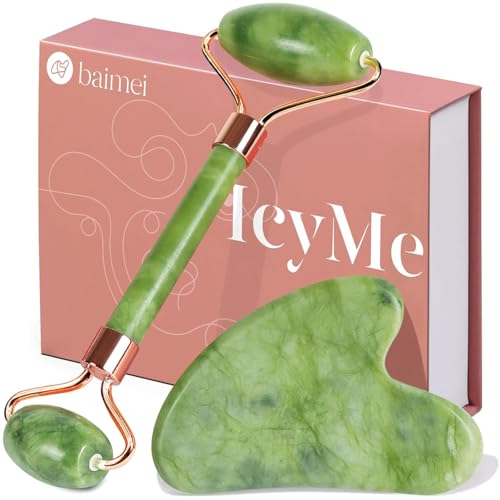
The BAIMEI set is a 2 Piece Set in green jade, 3.53 oz total, packed at 0.98 x 5.71 x 3.54 in, model JK-0052. That combination gives you a notched stone for the jaw and cheekbone plus a roller for the thinner skin near the eyes and along the brow. No other pick here offers two shapes.
BAIMEI says the jade can be chilled or frozen for puffiness, and describes a reinforced frame that resists loosening, with polished stone for quiet rolling. The listing also recommends using the roller with serum or facial oil to reduce pulling, which is precisely the dry-skin instruction I would give anyway. It is the second-cheapest pick here, so the second grip shape costs very little.
Jade's weakness is jade. Stone chips, rollers loosen over time, and a set with moving parts has more to go wrong than a single flat blade. Like the Rena Chris pick, it arrives without any slip in the box, and only one seller lists it. Against the ANUA cream it wins on coverage and loses on being incomplete.
Pros:
- Only two-shape option in this set
- Second-cheapest pick here
- Jade can be chilled before use
- Roller reaches under-eye and brow zones
- Arrives in a gift box
Cons:
- No oil or cream included
- Jade can chip if dropped
- Roller has moving parts that can loosen
- Only one seller lists it
4. Kate Blanc Cosmetics Organic Jojoba Oil for Hair — Best minimal setup
Four times the volume of the other oil here, in amber glass, for less money.

Best for: pairing with a tool you already own Skip it if: you want a tool in the box
If you already have a stone, this is the slip problem solved. Kate Blanc ships 2 Fl Oz in a 4.5 x 1.4 x 1.4 in amber glass bottle, golden in colour, model 1820v. That is four times GEMELLE's 0.5 fl oz for a lower price position, which makes it the most oil per unit cost in the set.
The listing describes USDA Certified Organic jojoba that is 100% pure, cold-pressed, unrefined and hexane-free, free of additives, preservatives and artificial fragrance, bottled in the USA. Amber glass is a functional choice rather than a decorative one: it blocks the light that degrades oil over time, which matters when a 2 fl oz bottle takes months to finish. Fragrance-free is also the safer bet if your dry skin is reactive.
The obvious limit is that there is no tool. Jojoba is also a lighter, faster-absorbing oil than a thick balm, so on very dry skin you may want two passes rather than one. Against GEMELLE it wins decisively on volume and loses on the botanical extras.
Pros:
- Largest oil volume here at 2 fl oz
- Amber glass protects the oil from light
- No added fragrance or preservatives
- Cheaper than the other oil in this set
- Works with any tool you already own
Cons:
- No gua sha tool included
- Absorbs quickly, may need a second pass
- Heaviest shipped item here at 1.11 lb
- Nothing in the listing addresses dryness specifically
5. GEMELLE Lymphatic Gua Sha Face Oil — Best for families
A small, botanical-led oil built for shared use rather than heavy solo use.
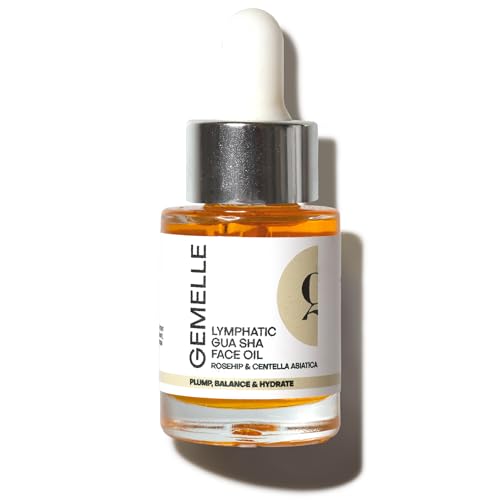
Best for: a shared bathroom oil used by more than one person Skip it if: you go through face oil quickly
GEMELLE's bottle is 0.5 Fl Oz at 3.25 x 1.5 x 1.5 in, which is the smallest footprint of any pick here. That compactness is the case for a shared shelf: it sits in a cabinet without claiming space, and several drops per face means a household can pass it around for a while before anyone notices.
GEMELLE describes an oil formulated for optimal glide, with High-Altitude Rosehip for radiance and Bakuchiol as a plant-based retinol alternative. The directions say to warm several drops in your hands and massage into clean, dry skin, and the listing notes it pairs with jade gua sha stones and lymphatic drainage tools. Bakuchiol is worth knowing about if retinol has irritated you before, though the strength here is not published, so I would not build a plan on it.
Volume is the problem. At 0.5 fl oz this is the most expensive oil here by a wide gap on a per-use basis, and it is the slowest seller of the six. If gua sha becomes a nightly ten-minute habit, you will reorder often. Against Kate Blanc, you are paying for the botanicals rather than the supply.
Pros:
- Smallest footprint here at 3.25 in tall
- Bakuchiol listed as a retinol alternative
- Rosehip included for radiance, per the brand
- Designed and described specifically for tool glide
- Directions written for gua sha use
Cons:
- Only 0.5 fl oz, a quarter of Kate Blanc's volume
- Most expensive oil per use in this set
- Slowest seller of the six
- No tool included
6. SEFVAKO Lymphatic Contour Face Brush — Best upgrade
A dual-ended brush with a jade edge, for people expanding a routine rather than starting one.
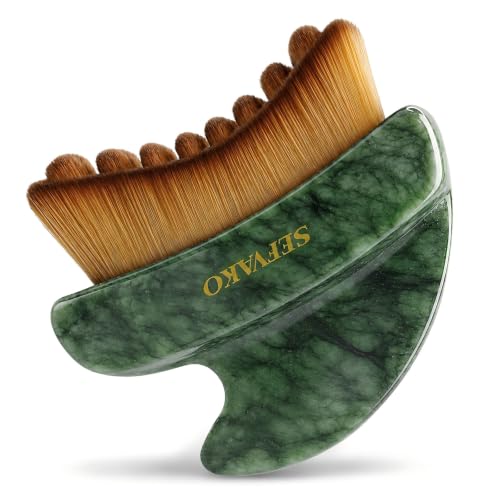
Best for: adding dry brushing to an existing routine Skip it if: your skin flakes and dry friction stings
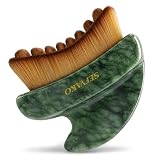
SEFVAKO packs two techniques into one handle: soft bristles at one end, a cool-touch jade gua sha edge at the other, in brown and green, model SEFVAKO_001, at 1.1 x 3.54 x 3.54 in. That is the only pick here combining a brush and a stone edge in a single tool.
The brand quotes 0.075mm ultra-soft synthetic bristles and calls the brush suitable for daily use on all skin types including sensitive skin. The listing describes a morning de-puff pass along the jawline and cheeks, a night pass using the brush with a serum or oil, and a jade edge for contouring. It also says the tool is made with eco-friendly materials and cleans by rinsing and air drying.
Here is where dry skin needs to be careful. Facial dry brushing is friction without lubricant, and on tight or flaking skin that is the opposite of what helps. The jade edge still works with oil, so half the tool is useful to you and half may not be, which is a poor deal at a mid-range price position. It is also the slowest seller in this set and only one seller lists it.
Pros:
- Only brush-plus-jade combination here
- Bristles quoted at 0.075mm by the brand
- Compact 1.1 in depth stores flat
- Rinse and air-dry cleaning, per the listing
- Two techniques in one handle
Cons:
- Dry brushing can aggravate flaking skin
- Half the tool is less useful on dry skin
- No oil or cream included
- Slowest seller here alongside GEMELLE
Stone, steel or a cream with a roller built in?
Three materials show up in this set, and the differences are smaller than the marketing suggests. Here is what actually separates them.
- Jade holds cold well and can be chilled or frozen, which BAIMEI calls out directly. It is also the only material here that chips. A cracked edge is a sharp edge.
- Stainless steel self-cools without a fridge, cleans with soap and water, and survives drops. Rena Chris leans on exactly that durability point. The downside is that cold metal on tight, dry skin can feel harsh first thing in the morning.
- A moulded head on a tube, as on the ANUA cream, cannot be chilled and cannot be replaced. What it can do is deliver slip and pressure in the same motion, which is why it leads.
The order that matters for dry skin runs: slip first, edge shape second, material third. Nobody has ever failed at gua sha because they bought jade instead of steel. Plenty of people have failed because they used a dry tool on a dry face and it hurt.
What the listings do not tell you about dry skin
Five of these six listings are honest about being general-purpose. That gap is worth naming, because it changes how you shop.
No listing here publishes a warranty. Not one of the six. Tools are simple objects, so that matters less than it would for an appliance, but if you were hoping for cover on a loosening roller, it is not on offer.
No pick states an ingredient concentration. ANUA names retinol, collagen and peptides. GEMELLE names rosehip and bakuchiol. Neither publishes a percentage, so you cannot judge strength before buying.
Availability is thin across the set. Three picks list a single seller: Rena Chris, BAIMEI and SEFVAKO. The three products with two sellers are the ANUA cream, the GEMELLE oil and the Kate Blanc jojoba.
Nothing here is certified for dry skin. ANUA and SEFVAKO both mention sensitive skin, which overlaps with dryness but is not the same condition. Judge the medium, judge the volume, and treat the dry-skin label as your own decision rather than a product credential.
How to build a routine around the best gua sha for dry skin
Buying the tool is the easy part. Using it in an order that helps dry skin is what gets results.
- Cleanse and leave skin slightly damp. Oil over damp skin holds longer than oil over bone-dry skin.
- Apply more slip than feels sensible. If the tool catches at any point, you did not use enough. Several drops of the GEMELLE oil, or a generous press of the ANUA cream.
- Work outward and upward in short strokes. Jaw to ear, chin to jaw, cheekbone to hairline. Light pressure, repeated, beats heavy pressure once.
- Save the roller or brush for the delicate zones. The BAIMEI roller suits under-eye and brow. Skip the SEFVAKO bristles anywhere skin is flaking.
- Clean the tool after every session. Steel takes soap and water. Jade wants a wipe and a dry cloth. SEFVAKO says rinse and air-dry the brush.
- Reapply moisturiser afterwards. Massage has moved product around, not replaced what dry skin lost.
Two or three sessions a week is enough to judge whether you like it. Daily is fine once you know your pressure.
The verdict
Entry tier. The Rena Chris steel tool is the cheapest of the six and the most durable object here, with the thinnest edge at 0.16 in. Buy it if you already own a facial oil. The BAIMEI 2-piece jade set sits just above it and buys you a second grip shape, so it is the better entry pick if you want to work the under-eye area too. Neither includes slip, which is the whole point of the tier.
Middle tier. Kate Blanc's 2 fl oz jojoba in amber glass is the sensible mid-range purchase and the best supply-per-cost in the set, but it is an oil, not a tool. SEFVAKO's dual-ended brush costs similar and gives you a jade edge plus bristles, though facial dry brushing is a poor fit for skin that flakes.
Premium tier. The ANUA Collagen Retinol Refining Gua Sha Cream wins the whole set because it solves the medium and the tool in one 2.71 fl oz tube, and on dry skin the medium is what fails first. GEMELLE's 0.5 fl oz oil sits in the same tier without a tool, and its exact advantage is formulation: it names bakuchiol as a plant-based retinol alternative, which is the reasonable choice if retinol has irritated you before. The cutoff is whether you own a tool. If you do, buy oil. If you do not, buy the ANUA.
FAQ
Is the best gua sha for dry skin worth buying at all?
The best gua sha for dry skin is worth buying if you will actually pair it with enough slip. A stone used on under-lubricated skin tugs, and tugging on dry skin is worse than doing nothing. Where it earns its place is as a reason to spend three minutes massaging product in rather than patting it on. That habit alone is the return.
What should I look for in a gua sha tool for dry skin?
Look for a gua sha tool for dry skin with a smooth, unchipped edge, a shape that matches the area you want to work, and a plan for slip. Volume is the specification nobody checks: Kate Blanc's 2 fl oz outlasts GEMELLE's 0.5 fl oz by four times. Edge thickness matters too, and the Rena Chris tool is the thinnest here at 0.16 in.
ANUA cream or the Rena Chris steel tool?
ANUA cream or the Rena Chris steel tool comes down to what is already in your bathroom. The ANUA tube includes 2.71 fl oz of cream plus a W-shaped head, so it works out of the box, and it is the pick buyers here choose most often. The Rena Chris tool is the cheapest of the six and will outlive any tube, but you supply the oil yourself.
Can I use jojoba oil with any gua sha tool?
You can use jojoba oil with any gua sha tool in this set, and Kate Blanc's 2 fl oz bottle is the cheapest way to keep a steel or jade tool gliding. The listing describes it as 100% pure, cold-pressed and hexane-free with no added fragrance. It absorbs fairly quickly, so on very dry skin apply a second pass mid-session.
What is the most common gua sha mistake on dry skin?
The most common gua sha mistake on dry skin is pressing harder when the tool starts to drag. Drag means you have run out of slip, not that you need more force. Stop, add oil or cream, and continue with the same light pressure. The second mistake is dry brushing a flaking face, which is why SEFVAKO's bristle end suits some routines and not others.
If your bathroom shelf is currently empty, start with the ANUA cream: one tube, one motion, no second purchase, and no session where you run out of glide halfway along the jaw. If you already own a stone you like, the honest upgrade is not another stone. It is 2 fl oz of jojoba and the discipline to use enough of it. Either route gets you to the same place, which is three unhurried minutes with a tool that never catches. That, more than the material it is cut from, is what dry skin responds to.