Best Gua Sha for Combination Skin: BAIMEI Leads
Six gua sha tools compared for combination skin, from a 1.8 oz travel jade to a stainless steel scraper and a built-in applicator neck cream.

By Harley BradleyUpdated 16 min read
On this page
- Best gua sha for combination skin at a glance
- Who this guide is not for
- How I narrowed six picks from a crowded category
- 1. BAIMEI IcyMe Gua Sha & Jade Roller Set — Best overall
- 2. medicube PDRN Collagen Gua Sha Neck Wrinkle Cream — Best premium
- 3. Ditind Jade Stone Gua Sha Massage Tool — Best lightweight
- 4. Rena Chris Stainless Steel Gua Sha — Best budget pick
- 5. PLANTIFIQUE Jade Gua Sha — Most versatile
- 6. BAIMEI IcyMe Rose Quartz Roller & Gua Sha Set — Best upgrade
- Does combination skin actually need a special gua sha?
- Jade, rose quartz or stainless steel: which works best?
- How to use a gua sha without dragging on dry patches
- What the listings do not tell you
- The verdict
- FAQ
The best gua sha for combination skin is the BAIMEI IcyMe Gua Sha and Jade Roller Set, because its 3.53 oz jade pair handles both the oilier T-zone and drier cheeks with one cool, low-drag tool. If you want built-in product delivery for the jawline and neck, the medicube PDRN Collagen Gua Sha Neck Wrinkle Cream is the better buy, pairing 3.17 oz of firming cream with a curved massage head.
Best gua sha for combination skin at a glance
| Pick | Material | Weight | Price |
|---|---|---|---|
Best overall BAIMEI IcyMe Gua Sha & Jade Roller Set |
Natural jade | 3.53 oz | Check Price |
Best premium medicube PDRN Collagen Gua Sha Neck Cream |
Cream with built-in head | 3.17 oz | Check Price |
Best lightweight Ditind Jade Stone Gua Sha |
Natural jade | 1.8 oz | Check Price |
Best budget pick Rena Chris Stainless Steel Gua Sha |
Stainless steel | 3.17 oz | Check Price |
Most versatile PLANTIFIQUE Jade Gua Sha |
Authentic jade | 2.12 oz | Check Price |
Best upgrade BAIMEI IcyMe Rose Quartz Roller & Gua Sha |
Rose quartz | 3.53 oz | Check Price |


Who this guide is not for
This roundup covers gua sha tools sold on Amazon. If you have active acne, broken skin, rosacea flares, or you're on prescription retinoids that leave the face raw, skip the category and speak with a dermatologist first. Scraping stones over inflamed skin makes things worse, not better.
The keyword here is "combination skin," but Amazon's search does not filter for that trait. None of these listings is labeled or certified for combination skin specifically. What you're really choosing is a smooth-edged tool that glides without drag, and a material that either warms up or stays cool depending on your routine. If you want a device that treats oily zones and dry zones differently, no handheld stone will do that. A good serum layered under the tool does the real work.
If you already own a favorite gua sha and are only looking for a specific ritual add-on, jump to the medicube pick, which is a cream product with a built-in applicator rather than a standalone stone.
How I narrowed six picks from a crowded category
Gua sha listings on Amazon run into the thousands. I cut the field down using disqualification first, then compared what survived.
Three cuts did most of the work. First, listings without published dimensions or weight went, because you cannot judge whether a stone fits a jawline curve if the seller won't state the size. Second, anything with vague material claims lost out to listings that named jade, rose quartz or stainless steel directly. Third, sets bundling more than two tools were dropped, because a starter should learn one shape before adding more.
What remained were six tools spanning three materials and a wide range of weights, from 1.8 oz to 3.53 oz. Two are jade roller-and-stone sets, one is a solo jade stone, one is a solo jade sculptor, one is stainless steel, and one is a cream with a built-in gua sha head. That spread matters for combination skin, where the right answer depends less on the stone itself and more on how it pairs with your existing serum layer.
- Screened for stated material, weight and dimensions
- Cut listings with only marketing claims and no specifications
- Kept a range spanning entry to premium price positions
- Included one hybrid product (cream plus applicator) for readers who want a shortcut
1. BAIMEI IcyMe Gua Sha & Jade Roller Set — Best overall
A natural jade set that pairs a smooth sculpting stone with a quiet roller, at a middle price for this shortlist.
Best for: combination skin routines that alternate oils and lightweight serums Skip it if: you want a single sculpting stone without a roller
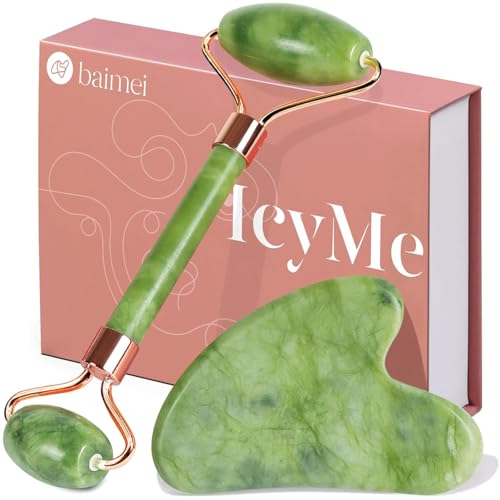
The BAIMEI IcyMe set is the pick for combination skin because it hands you two tools with the same stone, so you can match the pass to the zone. The 3.53 oz set measures 0.98 x 5.71 x 3.54 in, which covers the cheek in a couple of long strokes and still gets into the curve under the jaw. Natural jade is the standard starter material for a reason: it stays cool to the touch and glides without much friction if you've laid down a thin layer of oil or a slippery serum first.
BAIMEI says the tools can be chilled or frozen for extra puffiness relief, which is where combination skin actually benefits: cool jade slows down morning oil flow in the T-zone while soothing the drier cheeks. The listing also claims a reinforced frame on the roller so it won't loosen with daily use. Against the rest of this set, its trade-off is that it doesn't come with a heftier sculpting edge like the PLANTIFIQUE, and it's not as light for travel as the Ditind.
Pros:
- Two-piece format covers rolling and sculpting
- 3.53 oz weight gives control without arm fatigue
- Natural jade holds cool temperature well
- Reinforced roller frame per the listing
- Sells faster than most tools in this shortlist
Cons:
- Roller adds bulk if you only want one stone
- No stated warranty in the listing
- Larger footprint than the Ditind for travel
2. medicube PDRN Collagen Gua Sha Neck Wrinkle Cream — Best premium
A 3.17 oz firming cream with a built-in curved gua sha head, designed for the jawline down to the décolleté.

Best for: targeting the jawline, neck and décolleté with one product Skip it if: you already own a separate neck cream and want a bare stone
This is the odd one out and the most expensive pick here, and it earns its place because it changes the shape of the ritual. Instead of a bare stone that needs an oil layer, medicube gives you a 3.17 oz tube with a curved applicator head that dispenses cream as you glide. Medicube says you turn the applicator, squeeze, and then work the head along the jawline, neck and décolleté. For combination skin, that matters below the face: the neck runs drier than the T-zone, so extra emollient during the massage is genuinely useful.
The listing credits PDRN and Volufiline 5% for the firming claim and says the design targets "tech neck" horizontal lines. Those are the manufacturer's claims, not measured outcomes. Against the rest of the set, the trade-off is obvious: you cannot chill it in the fridge without risking the formula, and the applicator head is fixed, so you can't use the tool without depleting cream. It sells faster than any other product on this list, which suggests the format resonates with readers who don't want a separate stone-and-oil step.
Pros:
- Cream and applicator combined in one product
- Built-in curved head hugs the jawline
- 3.17 oz tube covers face-down to décolleté
- Slimmest addition to an existing routine
- The fastest-selling pick in this set
Cons:
- The most expensive pick here
- Cannot separate the head from the cream
- No option to chill or freeze the tool
- Applicator wears out with the tube
3. Ditind Jade Stone Gua Sha Massage Tool — Best lightweight
A featherweight 1.8 oz jade stone that packs flat for travel and beginner routines.

Best for: travel and quick morning depuffing sessions Skip it if: you want serious heft for slower lymphatic work
At 1.8 oz and 0.5 x 2.2 x 3.2 in, the Ditind is the lightest tool in this set by a noticeable margin. That matters more than it sounds. Combination skin often flares in the T-zone after a flight or a hot night, and a small stone that fits a Dopp kit means you actually pack it. It's also the second-cheapest of the six, so it's low-stakes if you lose it on the road.
Ditind describes the tool as 100% natural jade and calls out its ultra-smooth surface. The listing says the smaller board can activate trigger points or reach areas that a large stone can't cover, which lines up with the compact 3.2 in profile: it's designed for the sides of the nose, around the brow, and along the jawline rather than long cheek sweeps. Against the rest of the set, its weakness is that light stones give less feedback under the fingers, so beginners can end up pressing harder than they should. It also has the slowest sales pace of the six here, suggesting it's a niche choice rather than a first stone.
Pros:
- 1.8 oz weight is easiest to travel with
- Compact 0.5 x 2.2 x 3.2 in footprint
- Second-cheapest pick in this shortlist
- Small edges reach nose and brow curves
Cons:
- The slowest seller of the six here
- Light stone gives less tactile feedback
- Not ideal for long, sweeping cheek strokes
4. Rena Chris Stainless Steel Gua Sha — Best budget pick
A 3.17 oz stainless steel scraper that self-cools and doesn't shatter if dropped.

Best for: beginners who want a self-cooling metal tool Skip it if: you prefer the ritual feel of natural stone
Rena Chris is the cheapest of the six and the only metal option in the set. It weighs 3.17 oz and measures 0.16 x 3.35 x 2.17 in, so it's thin and flat, closer to a card than a stone. Rena Chris says the stainless steel is self-cooling, which means you get the depuffing effect without needing to store the tool in the fridge overnight. For combination skin, that's a practical win in the morning: you pick it up, it's already cold enough to help calm oil flow in the T-zone.
The listing pitches this as a beginner tool and points to an included "Instruction of Use" booklet plus video tutorials on Amazon. Metal doesn't chip like stone, which matters if you keep your tool on a hard bathroom counter. Against the rest of the set, the trade-off is texture: some users find metal glides a little too fast on well-oiled skin, and the flat card shape doesn't hug the jaw as tightly as a curved stone. It also lacks the ritual weight of jade that a lot of people buy gua sha for in the first place.
Pros:
- Cheapest pick in this shortlist
- Self-cooling stainless steel per the listing
- Won't chip or shatter if dropped
- 0.16 in thickness slides into a bag flat
- Includes an instruction booklet
Cons:
- Metal feel divides preference
- Flat shape hugs the jaw less than curved stone
- Only one seller lists it
5. PLANTIFIQUE Jade Gua Sha — Most versatile
A compact 2.12 oz jade sculptor built for smaller, more targeted strokes.

Best for: small, precise work around the nose, brow and jaw Skip it if: you want long sweeping strokes across the cheeks
The PLANTIFIQUE stone lands in the middle of the set on weight, at 2.12 oz, but its 3.19 x 1.97 x 0.2 in dimensions mark it as a precision tool. The stone is small enough to work the sides of the nose and the space under the brow, which is where combination skin tends to hold tension and oil at the same time. PLANTIFIQUE describes it as authentic jade, handcrafted, and quality-inspected for durability.
The best gua sha for combination skin isn't always the biggest one. A smaller sculptor lets you slow down on the drier cheeks and speed up around the T-zone, which is exactly how a two-zone face needs to be treated. PLANTIFIQUE includes what the listing calls a detailed guide, which helps if you're not sure where to start. Against the rest of the set, its trade-off is coverage: you'll do more strokes to cover the same area a BAIMEI or medicube head would clear in one pass. It's also positioned at a premium price for a single stone, without the roller that the BAIMEI sets include at similar levels.
Pros:
- Compact 3.19 x 1.97 x 0.2 in stone
- 2.12 oz weight is easy on the wrist
- Authentic jade per the listing
- Detailed usage guide included
Cons:
- Slower to cover the full face
- Premium price for a single stone
- No roller in the box
- Only one seller lists it
6. BAIMEI IcyMe Rose Quartz Roller & Gua Sha Set — Best upgrade
A rose quartz two-piece with the same 3.53 oz footprint as the jade set, built around cooling depuffing.

Best for: morning routines that lean on cooling depuffing Skip it if: you dislike pink stones or want a single sculpting edge
The rose quartz version of BAIMEI's IcyMe set matches the jade twin in size and weight: 3.53 oz total, 0.98 x 5.71 x 3.54 in. What changes is the stone. Rose quartz feels cooler in the hand than jade for many people and holds fridge temperature longer, which is why BAIMEI says keeping it chilled gives a stronger morning depuffing hit. For combination skin that wakes up shiny in the T-zone but tight on the cheeks, cool stone is more useful than warm stone.
BAIMEI positions this as the sculpting-and-lifting version of the set, and the listing describes the gua sha piece specifically as a jawline sculptor. Because the size mirrors the jade set, everything I said about the winner applies here: same coverage, same reinforced roller claim, same fridge trick. Against the rest of the set, the real trade-off is price. It sits above the jade version in this shortlist for a stone type that's a preference rather than a performance difference. Choose it if pink stone matters to you, or if you already own jade and want a second temperature.
Pros:
- Two-piece rose quartz format
- 3.53 oz total for comfortable control
- Holds cool temperature well
- Designed as a jawline sculptor per the listing
- Several sellers stock it
Cons:
- Costs more than the jade IcyMe version
- Same coverage as the winner, at a higher position
- Pink stone is a style preference
Does combination skin actually need a special gua sha?
Not really. Amazon's own search treats "combination skin" as a soft filter here, which is why the modifier is partial in this category. No stone in this shortlist is certified or engineered for combination skin as a category. Every gua sha listed will work on every skin type as long as the edges are smooth and you use enough slip.
What actually decides the pick for combination skin is the routine wrapped around the tool. The T-zone benefits from a cooler stone and lighter serum. The drier cheeks need a heavier oil layer under the same stone to avoid drag. That's a two-step change in your product layer, not a two-tool change in your gua sha. The BAIMEI jade set wins overall because its roller handles the T-zone quickly while the stone slows down for the cheeks, but the honest answer is that your serum matters more than your stone.
Jade, rose quartz or stainless steel: which works best?
Three materials show up in this shortlist and each has a real trade-off.
- Jade stays naturally cool and offers moderate glide. Four of the six picks use jade. It's the standard starter material, warms slowly to skin temperature, and can be chilled for extra depuffing. Combination skin gets the middle ground it needs.
- Rose quartz feels cooler for longer and holds fridge temperature better than jade. It's a preference-driven choice. Best for people who lean on cold as a morning depuffer.
- Stainless steel is the fastest to cool and the most durable. It doesn't chip, and Rena Chris says its steel is self-cooling. The trade-off is a firmer, less "ritual" feel and faster glide, which can drag on drier cheeks if you skimp on oil.
If you're picking your first tool and you cannot decide, jade is the safest default. If you already own jade and want to expand, rose quartz for cold mornings or stainless steel for durability are both defensible upgrades.
How to use a gua sha without dragging on dry patches
Combination skin punishes bad technique more than dry or oily skin does. The T-zone tolerates a fast pass; the cheeks don't. Here's the fix:
- Cleanse first, then apply a hydrating essence or a lightweight serum
- Add a facial oil, especially over the drier cheek zones
- Hold the stone almost flat, not perpendicular
- Sweep from the center of the face outward, in long strokes
- Repeat each stroke three to five times before moving on
- Finish with lymph nodes at the neck, moving downward
The most common mistake is skipping the oil step on the T-zone because it already feels slick. It isn't slick enough. Sebum is not a lubricant for a gua sha edge. A cheap facial oil layered under the tool prevents the microtears that redness and irritation come from. If your cheeks feel tight halfway through a session, stop and add more oil rather than pressing harder.
What the listings do not tell you
None of these six listings state a warranty, a return window, or a country of origin. That's normal for the category but worth flagging. Stones can arrive with hairline cracks that only show up after a week of use, and there's no manufacturer guarantee here to fall back on. Buy through a seller with a clear return policy if that matters to you.
The listings also don't tell you how well the stones hold cool. BAIMEI and Ditind mention chilling or freezing, but none specifies how long the material holds temperature once it's out of the fridge. In practice, most stone tools go warm within four or five minutes of contact, which is fine for a full-face pass. If you want longer cold, stainless steel is the better choice, or store two stones so you can rotate.
Finally, "natural jade" on Amazon is not a certified label. The best gua sha for combination skin, at this price, is one where the edges are smooth and the tool feels balanced in your hand. That is a shopping consideration, not a spec.
The verdict
If you're picking one gua sha for combination skin and you want a tool that handles both the oilier T-zone and the drier cheeks, buy the BAIMEI IcyMe Gua Sha and Jade Roller Set. At 3.53 oz across two natural jade pieces, it gives you a fast roller for T-zone passes and a smooth sculptor for slower cheek work, and it sits at a middle price for this shortlist. The cutoff is simple: if you want stone-plus-roller under one buy, this is it.
If your routine is already built and you want to add jaw and neck care specifically, the medicube PDRN Collagen Gua Sha Neck Wrinkle Cream is the smarter buy. Its 3.17 oz tube with a built-in curved applicator replaces both a neck cream and a jaw stone in one step, and it targets a zone most face-first gua sha tools miss entirely.
If you travel most weeks and want something that fits a Dopp kit, the Ditind at 1.8 oz is the pick. If you drop things and want a tool that survives, the Rena Chris stainless steel at the cheapest position in this set is the right call.
FAQ
Is a gua sha worth it for combination skin?
Is a gua sha worth it for someone with combination skin? Yes, provided you use enough facial oil under the tool. Combination skin drags easily on the drier cheeks if you skimp on slip, and a bad pass can leave redness. Used correctly, a jade or rose quartz stone helps with morning puffiness and jawline tension. It's a maintenance tool, not a treatment.
What's the difference between jade and rose quartz for gua sha?
The difference between jade and rose quartz for gua sha is mostly cooling behavior and preference. Jade stays cool at room temperature and warms slowly on skin. Rose quartz feels cooler for longer and holds fridge temperature better. Neither performs objectively better on combination skin. Four of the six picks here are jade because it's the standard starter material. Rose quartz is a preference-driven upgrade.
BAIMEI IcyMe jade or rose quartz: which should I buy?
BAIMEI IcyMe jade or rose quartz share the same 3.53 oz format and the same 0.98 x 5.71 x 3.54 in dimensions. The jade set is the middle-priced pick here and works as an all-purpose starter. The rose quartz set costs more and appeals to people who want longer cooling and don't mind the pink color. Buy jade first, rose quartz as a second stone.
How often should I use a gua sha on combination skin?
How often you should use a gua sha on combination skin depends on your baseline. Three to five sessions a week is a reasonable start. Daily is fine if your skin tolerates it and you use enough slip. Watch for redness that lingers past 20 minutes; that's a sign of too much pressure or too little oil. Stop for a few days if you see any irritation in the T-zone.
Do metal gua sha tools work as well as stone?
Do metal gua sha tools work as well as stone tools for combination skin? Yes, with one caveat. Stainless steel like the Rena Chris self-cools quickly and won't chip, which suits people who value durability. It also glides faster than jade, which can drag on drier cheeks without enough oil. Add an extra pump of facial oil when using metal, and you'll get a comparable result to jade.
Six tools, three materials, one deciding factor. Pick the material that fits your morning: jade if you want a balanced starter, rose quartz if cold matters most, stainless steel if you want the cheapest tool that won't break. The BAIMEI IcyMe jade set is the safest first buy for combination skin because its two-piece format lets you match the pass to the zone without switching products. Whatever you choose, budget for a good facial oil in the same order. The stone is the tool; the oil is what makes it work on skin that lives in two states at once.