Best Gua Sha for Dark Circles: Rena Chris Wins

Six gua sha tools lined up by material, weight and set contents, with clear picks for cooling under-eye work, daily rituals, family sharing and travel.

By Harley BradleyUpdated 15 min read
On this page
- Best gua sha for dark circles at a glance
- How I narrowed six gua sha tools down
- Can a gua sha really help dark circles?
- 1. Rena Chris Gua Sha Facial Tools — Best overall
- 2. BAIMEI IcyMe Gua Sha & Jade Roller Set — Best for beginners
- 3. BAIMEI IcyMe Rose Quartz Roller & Gua Sha Set — Best for heavy use
- 4. Kitsch Stainless Steel Guasha Tool — Best compact
- 5. Ditind Jade Stone Gua Sha Set — Best for families
- 6. CHOSIN Olive Wood Gua Sha — Best premium
- Metal, jade, quartz or wood: which suits under-eye skin?
- How to use a gua sha around the eyes
- What to look for if none of these six fit
- The verdict
- FAQ
The best gua sha for dark circles here is the Rena Chris Stainless Steel Gua Sha, a 3.17 oz metal tool with self-cooling properties the brand highlights for morning under-eye work. If you want a two-piece kit that pairs a scraper with a chilled roller, the BAIMEI IcyMe Jade set is the better buy, weighing 3.53 oz and shaped for lymphatic sweeps across the cheekbone.
A note before the picks. Amazon's search returned these six for "gua sha for dark circles", but none of the listings publishes clinical data on pigment or vascular shadowing under the eye. Treat the dark-circle angle as a use case for cool, gentle lymphatic work, not a promised cure. The tools that shine here are the ones that stay cold, sit lightly on thin skin and glide without dragging.
Best gua sha for dark circles at a glance
| Pick | Material | Weight | Price |
|---|---|---|---|
Best overall Rena Chris Gua Sha |
Stainless steel | 3.17 oz | Check Price |
Best for beginners BAIMEI IcyMe Jade Set |
Jade + jade roller | 3.53 oz set | Check Price |
Best for heavy use BAIMEI IcyMe Rose Quartz Set |
Rose quartz + roller | 3.53 oz set | Check Price |
Best compact Kitsch Stainless Steel Guasha |
100% stainless steel | 3.14 oz | Check Price |
Best for families Ditind Jade Two-Piece Set |
Natural jade | 1.8 oz set | Check Price |
Best premium CHOSIN Olive Wood Gua Sha |
Olive wood | 1.06 oz | Check Price |



How I narrowed six gua sha tools down
I lined up the published specifications side by side and made three cuts. First, anything with no stated material was out, because the surface against thin under-eye skin decides comfort. Second, anything without a weight figure was out, because a gua sha that is too heavy pulls skin instead of gliding. Third, I split the set into cooling-first tools and gentleness-first tools, because those two priorities pull opposite directions when you are working on dark circles.
Here is how the six break down:
- Two stainless steel tools, at 3.17 oz and 3.14 oz. Nearly identical in weight and dimensions.
- Two jade options, one paired with a roller at 3.53 oz, one a family-friendly two-piece at 1.8 oz.
- One rose quartz set at 3.53 oz with a matching roller.
- One olive wood piece at 1.06 oz, the lightest of the six.
The stainless steel and stone tools cool fastest and hold cold longest, which matters for morning puffiness. Wood does not, and it is not meant to. That single split explains most of the ranking below.
Three of the six ship as two-piece sets: two jade, one rose quartz. If you already own a roller, that pushes you toward the single-piece metal tools or the wooden one.
Can a gua sha really help dark circles?
Can a gua sha really help dark circles? Partly, and only in one specific way. Dark circles come from three sources: pigmentation, thin skin showing blood vessels, and fluid pooling that casts a shadow. A cool gua sha stroked outward from the inner corner can reduce that fluid pooling for a few hours, which softens the shadow. It will not lighten pigment and it will not thicken skin. Treat it as a morning de-puffing ritual, not a treatment.
1. Rena Chris Gua Sha Facial Tools — Best overall
A 3.17 oz stainless steel scraper that holds cold longer than stone and glides cleanly along the orbital bone.
Best for: cooling puffy under-eyes on tired mornings Skip it if: you prefer a warm, softer stone against the skin
This is the pick that best answers the question in the title. Stainless steel is non-porous, easy to wipe clean and, crucially for dark circles, holds cold from the fridge for far longer than jade or quartz. Rena Chris highlights "self-cooling properties" in the listing, and the 3.17 oz weight sits close to the Kitsch metal tool at 3.14 oz, so the two are near-twins on the scale. The 0.16 x 3.35 x 2.17 in profile is thin enough to slide along the socket without catching on the brow bone.
You get one piece, not a set, which is why it lands cheapest here. Rena Chris says the tool works well with oils or lotions and ships in a gift box with an instruction booklet, which matters if you have not used a gua sha before. Against the two-piece jade and quartz kits, it trades the roller for a colder, faster-de-puffing scraper. That is the right trade if under-eye puffiness is the reason you are shopping.
Pros:
- Stainless steel holds cold longer than stone
- Non-porous, wipes clean with soap and water
- Thin 0.16 in edge suits the orbital bone
- Single piece keeps the setup simple
- Ships in a gift box with an instructions booklet
Cons:
- Only one piece, no roller included
- Metal feels harsher than stone on very sensitive skin
- The listing does not publish a warranty
2. BAIMEI IcyMe Gua Sha & Jade Roller Set — Best for beginners
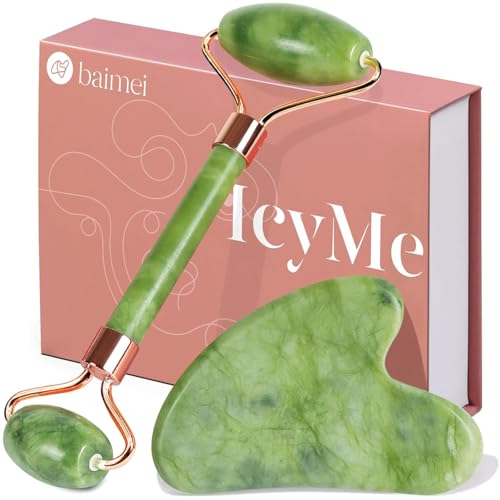
A jade scraper plus a matching roller, sold together, so a first-time user has both formats to try.
Best for: first-time users who want a roller and scraper together Skip it if: you already own a jade roller
If you are new to gua sha and unsure whether you will prefer rolling or scraping, this set removes the decision. It is a 3.53 oz two-piece kit in natural jade, 0.98 x 5.71 x 3.54 in in the box, with a reinforced-frame roller BAIMEI says will not loosen with long-term use. The scraper is shaped for jawline sweeps and cheekbone lifts.
For dark circles specifically, the small end of the roller is the interesting piece: it fits under the eye and rolls fluid outward without the pressure a scraper edge applies. BAIMEI recommends chilling or freezing the tools first, which is the standard trick and works well with jade. The set sells faster than any other pick here, which is a signal that beginners keep reaching for it. Against the Rena Chris metal, jade warms up faster in the hand and does not hold cold as long, so it wins on gentleness and loses on cooling duration.
Pros:
- Two formats in one purchase: roller and scraper
- Reinforced-frame roller claim from BAIMEI
- Natural jade cools quickly in the fridge
- Small roller end fits the under-eye area
- Sells faster than any other pick here
Cons:
- Jade loses cold faster than stainless steel
- Two-piece format is bulkier for travel
- No published warranty on the listing
3. BAIMEI IcyMe Rose Quartz Roller & Gua Sha Set — Best for heavy use
A rose quartz version of the jade set, matched in weight and dimensions, for daily morning rituals.

Best for: daily morning routines with a stone kept in the fridge Skip it if: you want the coldest possible surface for de-puffing
Rose quartz behaves much like jade: it is a natural stone, it cools in the fridge, and it warms up as you use it. This set matches the BAIMEI jade kit almost exactly on the scale, both listed at 3.53 oz with 0.98 x 5.71 x 3.54 in dimensions. What you are choosing between the two is colour and, in the specification sheet, nothing else. The rose quartz set has two Amazon sellers listed rather than one, so stock spreads slightly wider.
BAIMEI recommends storing the tools in the fridge for a cool touch in the morning, using them with an oil or serum, and working upward from the jaw. The pointed end of the scraper fits along the tear trough for under-eye sweeps. This is the pick if you plan to use a gua sha every morning and want the routine to look and feel consistent from one week to the next. Against the metal tools, it trades cooling duration for a gentler feel.
Pros:
- Roller and scraper in matched rose quartz
- Two sellers stock it, wider availability
- Natural stone chills well overnight
- Pointed scraper end suits the tear trough
- BAIMEI notes packaging may vary
Cons:
- Warms up faster than stainless steel
- No warranty stated on the listing
- The premium price position offers no extra published capability over the jade set
4. Kitsch Stainless Steel Guasha Tool — Best compact
A 3.14 oz metal scraper with a 0.13 in profile, thin enough for a wash bag and easy to sanitise.

Best for: a small dresser, a gym bag or a carry-on Skip it if: you want a set with a roller included
The Kitsch metal tool and the Rena Chris are close cousins on the specifications sheet. Kitsch runs 3.14 oz, 0.13 x 3.3 x 2.4 in; Rena Chris runs 3.17 oz, 0.16 x 3.35 x 2.17 in. The Kitsch is very slightly thinner and lighter, which is why it takes the compact slot. Kitsch says the tool is 100% stainless steel and, because it is non-porous, easy to sanitise with soap and water. That hygiene point matters more than it sounds: porous stones cannot be scrubbed the same way after they touch oil and skin.
For dark circles, the shape and weight matter as much as the material. A 3.14 oz metal tool sinks nicely into the hand and lets gravity do most of the work, which is what you want along thin under-eye skin. Kitsch sits at the premium end of this set on price, so you are paying for finish and brand rather than a bigger tool. Against the Rena Chris, it is the marginally sleeker option; against the stone sets, it trades a roller for hygiene and cold retention.
Pros:
- 100% stainless steel, non-porous
- 3.14 oz, the lightest metal option here
- 0.13 in profile fits a small wash bag
- Wipes clean with soap and water
- Balanced weight the brand designs for lymphatic work
Cons:
- Single piece, no roller
- Premium price for what is essentially a twin of the Rena Chris
- Metal edge is less forgiving than stone on sensitive skin
5. Ditind Jade Stone Gua Sha Set — Best for families
A 1.8 oz two-piece jade kit with a large board and a smaller trigger-point piece, priced low enough to share.

Best for: two people sharing tools, or face and body use Skip it if: you need one substantial piece rather than two small ones
Ditind is the lightest set here at 1.8 oz combined, 0.5 x 2.2 x 3.2 in in the box, and it sits at the entry end of the price spread. You get a larger jade board plus a smaller piece Ditind says is shaped to reach trigger points and awkward body spots. The brand's listing frames it as a full-body tool as much as a face tool, so it makes sense in a household where one person wants to work shoulders and another wants to work under the eyes.
The trade-off is size. At 1.8 oz for the pair, each piece is smaller and lighter than the single-piece jade options in the BAIMEI sets. That is fine for the under-eye area, where you want a light touch, but you will notice the lack of heft on the jawline and neck. Ditind describes the surface as ultra smooth, and both pieces are natural jade rather than a composite. Two sellers stock it. Of the six, it is the slowest seller, which reads less as a red flag and more as a niche product for households that want two pieces at an entry price.
Pros:
- Two-piece jade set at an entry price
- 1.8 oz combined, easy to store
- Smaller piece works for trigger points
- Natural jade, not a composite
- Two sellers stock it
Cons:
- Lightest pieces here, less heft on the jaw
- Slowest seller of the six
- No warranty listed
- Smaller board than the BAIMEI jade scraper
6. CHOSIN Olive Wood Gua Sha — Best premium
A hand-polished olive wood scraper at 1.06 oz, the featherweight option for skin that reacts to cold metal or stone.

Best for: sensitive skin that reacts to cold stone or metal Skip it if: you rely on a chilled surface to reduce puffiness
This is the one pick that sits outside the cold-tool logic of the rest of the list. Olive wood does not chill in the fridge in any meaningful way, so if your goal is de-puffing through cold, buy one of the metal or stone options instead. What wood does well is warmth and gentleness. At 1.06 oz, this is by far the lightest tool here, and CHOSIN hand-polishes the surface to remove burrs. For sensitive skin, that combination matters.
CHOSIN describes a double-curved shape designed for the jaw and neck, and the brand pitches it as a face-and-body tool. For dark circles, use it after a cold compress rather than in place of one: the wood carries oil well and glides without pulling. It is the slowest seller of the six by a wide margin, which likely reflects how few gua sha shoppers are actively looking for a wooden option. The premium price position asks you to pay more for a material that will not de-puff as fast, which is why it lands last for this particular use case.
Pros:
- 100% olive wood, hand-polished
- 1.06 oz, the lightest tool here
- Double-curved edge shaped for the jaw
- Gentle on reactive skin
- Carries facial oil well
Cons:
- Does not hold cold like metal or stone
- Slowest seller of the six
- Highest price position for the least cooling
- Wood needs careful drying after use
Metal, jade, quartz or wood: which suits under-eye skin?
Under-eye skin is thinner than the skin on your cheek and reacts to two things: temperature and drag. The material you pick decides both.
- Stainless steel. Holds cold longest, glides most smoothly with a serum, wipes clean. The Rena Chris and Kitsch tools sit here. Best for morning puffiness.
- Jade. Cools in the fridge, warms up in the hand within a couple of minutes, feels softer than metal. BAIMEI's jade set and the Ditind two-piece use natural stone. Good middle ground.
- Rose quartz. Behaves like jade, differs in colour and surface feel. The BAIMEI rose quartz set is the only one here.
- Olive wood. Warm, light, gentle. Does not cool. CHOSIN is the sole wooden pick, and it is the outlier of the six.
For the specific goal of softening dark circles, metal beats stone beats wood on cooling duration. For gentleness on reactive skin, that order reverses. Two of the six are metal, three are stone, one is wood, so you have the full range in this set.
How to use a gua sha around the eyes
The under-eye area needs a lighter hand than the jaw. A few practical rules make the difference between a helpful ritual and skin that looks worse in an hour.
- Chill the tool for at least 20 minutes before a morning session, longer for stone.
- Apply an eye cream or a light facial oil first. Never drag a dry tool across dry skin.
- Use the flat side, not the edge, along the orbital bone.
- Sweep outward from the inner corner toward the temple, never inward.
- Keep the pressure light enough that the skin does not visibly stretch.
- Stop after two or three passes per side. More is not better here.
The best gua sha for dark circles is only as useful as the technique. A cold metal tool used aggressively is worse than a warm wooden one used gently. If you notice redness that lasts more than a few minutes, ease off the pressure or switch to the roller end if your set has one.
What to look for if none of these six fit
If you want to shop beyond this set, a few criteria matter more than the marketing.
- A published weight figure. Anything from 1 to 4 oz is workable for the face.
- A stated material, not just "stone". Natural jade, rose quartz, stainless steel, obsidian and bian stone all behave differently.
- A shape with a curve that matches the cheekbone, and a point or a small end for the tear trough.
- A non-porous surface if hygiene matters to you. Metal wins here; stone comes second; wood needs the most care.
- A brand that publishes cleaning instructions on the listing.
Avoid tools sold without material or weight figures. Avoid anything that promises to lighten pigment: that is not what a gua sha does. And skip heated or vibrating gadgets marketed as gua sha; they are a different category of tool with a different risk profile around the eye.
The verdict
The best gua sha for dark circles in this set is the Rena Chris Stainless Steel Gua Sha. Metal holds cold longer than stone, and cold applied gently outward from the tear trough is the mechanism that softens under-eye shadows. At 3.17 oz and 0.16 in thick, it has the weight to work without pressure and the thin edge to trace the orbital bone without catching. It also sits at the cheapest end of the six, which makes it the right default recommendation.
If sensitive skin rules out metal, the BAIMEI IcyMe Jade Set is the runner-up. The 3.53 oz two-piece pairs a scraper with a roller, and the small roller end fits under the eye without applying edge pressure. Jade warms faster than steel but still chills usefully overnight in the fridge, and BAIMEI sells more of this set than any other pick here.
If you already own a roller and want a second stone in a warmer tone, take the BAIMEI rose quartz version. If you travel with your tools, the Kitsch metal is the sleekest. The CHOSIN olive wood is the specialist choice for skin that reacts to cold. Everything else is context around those decisions.
FAQ
Does a gua sha actually reduce dark circles?
Does a gua sha actually reduce circles? Partly. It can move fluid away from under the eye, which reduces the shadow that puffiness casts, and cold contact can briefly tighten the skin. It will not lighten pigment or thicken thin skin, so results are temporary and cosmetic. Use it as a morning ritual for a couple of hours of improvement, not as a treatment.
Is a stainless steel gua sha worth it over jade?
Is a stainless steel gua sha worth the switch from jade? For under-eye work, yes. Metal is non-porous, wipes clean with soap and water, and holds cold from the fridge far longer than stone. The Rena Chris at 3.17 oz and the Kitsch at 3.14 oz both suit thin skin. Jade wins on softness and warmth in the hand, so pick by which matters more.
What weight should a face gua sha be?
What weight should a face gua sha aim for? Somewhere between 1 and 4 oz works for most people. The picks here span 1.06 oz for the CHOSIN olive wood up to 3.53 oz for the BAIMEI two-piece sets. Heavier tools do more of the work under their own weight, which reduces the pressure you apply. Lighter tools give you more control near the eye.
BAIMEI jade or BAIMEI rose quartz, which one?
BAIMEI jade or BAIMEI rose quartz? The two sets match on weight at 3.53 oz and on dimensions at 0.98 x 5.71 x 3.54 in, so the choice is largely colour and stone preference. Jade sells faster here, which suggests most shoppers pick it first. Rose quartz has two sellers listed rather than one, so it may be easier to find in stock. Neither has a published warranty.
Can I share a gua sha with someone else?
Can I share a gua sha with a partner or family member? Yes, if you clean it between users. Stainless steel is easiest to sanitise, as Kitsch notes about non-porous metal. Jade and rose quartz need a wipe with soap and water and a full dry. Olive wood, like the CHOSIN, needs the most care and should really be a personal tool. The Ditind two-piece set suits sharing because there are two boards.
The right next step is simple. Pull the Rena Chris up in a second tab, keep it in the fridge overnight, and give it two weeks of five-minute morning sessions before deciding whether the ritual earns a permanent slot on the shelf. Under-eye puffiness responds to cold and light outward pressure, and a stainless steel tool delivers both more reliably than stone or wood. If your skin flushes easily or reacts to cold metal, take the BAIMEI IcyMe jade set instead and use the roller end near the eye. Either way, the tool is the easy part. The technique in the how-to section above does most of the actual work.